Soup Dumplings
Soup dumplings, or xiaolongbao (小笼包), are often described in terms of novelty: the idea of soup contained within a dumpling. While distinctive, that alone does not explain the dish’s significance. At its best, the soup dumpling represents a precise balance of structure, temperature, and flavor, achieved through control rather than excess.
Originating in the Jiangnan region, particularly around Shanghai, xiaolongbao developed within a culinary tradition that values subtlety and technical refinement. The dish is not defined by bold seasoning or visual complexity, but by the successful integration of several fragile elements into a single, coherent bite.
Origins and History
As soup dumplings spread beyond their regional origins, standardization increased, especially through global restaurant groups such as Din Tai Fung. This expanded consistency and accessibility and established a widely recognized benchmark.
At the same time, standardization introduced uniformity that can reduce regional variation. In many markets, the focus shifted toward replicability rather than adaptation. As a result, xiaolongbao is now widely available, but truly exceptional execution remains limited.
Flavor Profile
The defining broth is produced indirectly. Cooks prepare a collagen-rich stock, usually from pork, chill it into gelatin, and fold that gelatin into the filling. During steaming, the gelatin liquefies and becomes the soup.
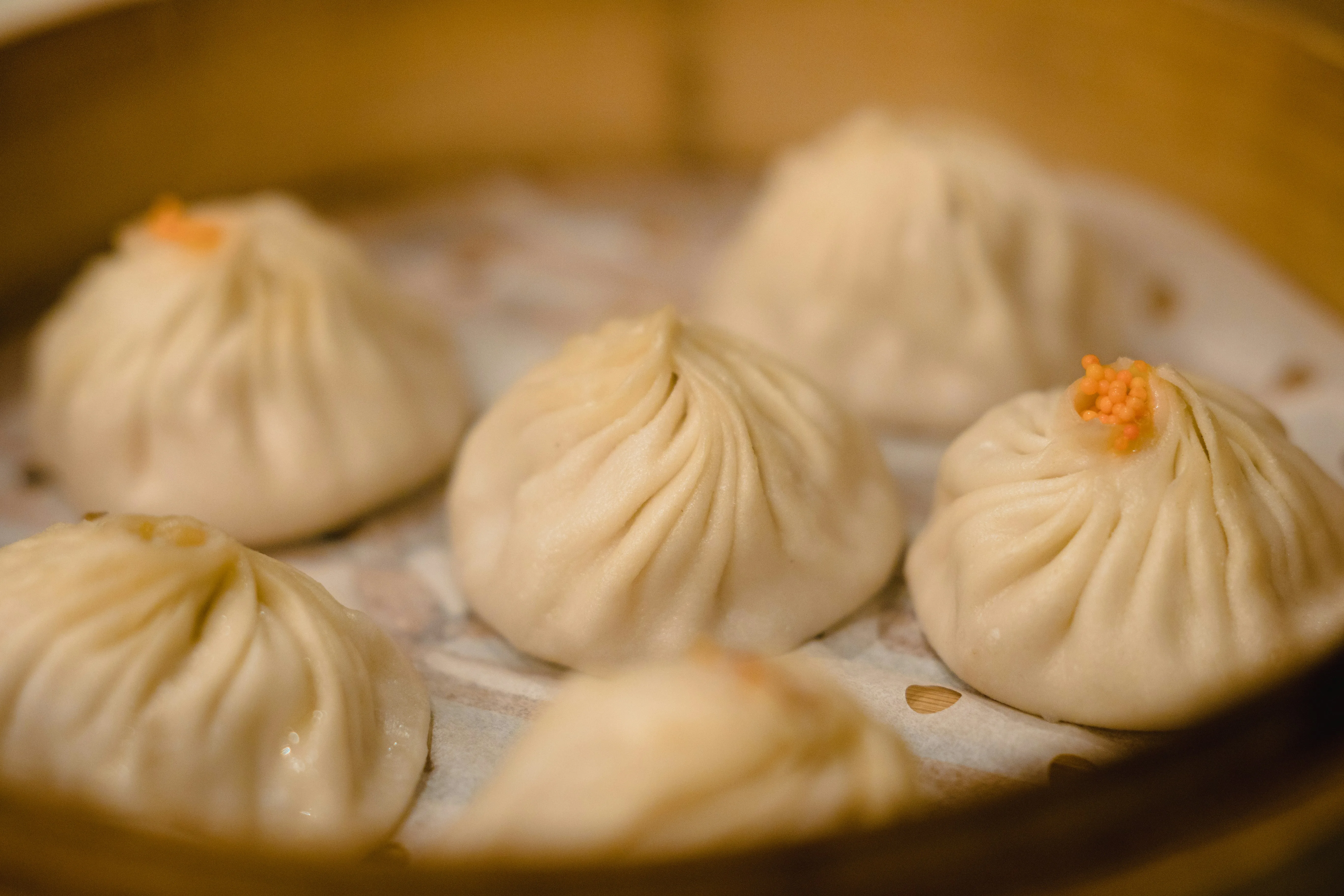
This process is structurally unstable. The wrapper must set quickly enough to contain liquid while remaining thin and elastic. Small deviations in dough thickness, filling ratio, or steaming time can cause breakage. The top pleats are functional, not decorative: they distribute tension and support the dumpling under pressure.
Ingredients and Variations
Core components are wrapper, filling, and gelatinized stock. Typical seasoning remains restrained so the broth stays clear and integrated with the meat.
Condiments are usually black vinegar and julienned ginger, used sparingly for contrast. Their role is to sharpen perception of the broth and filling, not to dominate flavor.
What Makes Great Soup Dumplings
A well-executed soup dumpling can be evaluated across four dimensions: wrapper, broth, filling, and proportion.
The wrapper should be thin, elastic, and uniform. The broth should be clear, aromatic, and integrated rather than greasy or diluted. The filling should be finely textured and balanced. Most importantly, the ratio between wrapper, filling, and soup must remain coherent. Failure in any one area compromises the whole.
Soup dumplings are best understood as a discipline of limits. Their impact lies not in complexity, but in precision.
How to Eat Soup Dumplings
Diners typically begin by placing the dumpling onto a spoon to catch any escaping liquid. Using chopsticks, the dumpling is lifted gently from the top knot, where the wrapper is slightly thicker and less likely to tear.
A small bite is then taken from the side to release steam and allow the broth to cool. The soup can be sipped directly from the spoon before the dumpling is finished in one bite, bringing together the wrapper, filling, and remaining broth.
Many restaurants serve thin slices of ginger with black vinegar alongside the dumplings. A small amount can be added for contrast, though well-made soup dumplings are often balanced enough to be enjoyed on their own.
Alternative Names
Common names and aliases used on menus.
- Xiaolongbao
- Xiao Long Bao
- Shanghai soup dumplings
Where to Find Soup Dumplings
Explore city-by-city coverage to compare where soup dumplings are executed with strong wrapper control, balanced broth, and consistent pleating.